
You regularly step onto the mat, taking care of your spine's flexibility and abdominal strength... but do you remember to train the over 50 muscles you have in your face? We often forget about them, treating skincare solely through the lens of creams and serums. Yet, it is the face that is the first zone to show the effects of stress, fatigue, and the passage of time.
At JOYINME, we believe in a holistic approach to beauty. For us, face yoga is more than just "making funny faces" in the mirror. It is an effective, natural gymnastics routine that restores the skin's glow, softens features, and acts as a non-invasive facelift.
We will show you a simple basic set, explain the mechanisms behind this method, and suggest how to adapt your practice to your age—regardless of whether you are interested in face yoga in your 40s, 50s, or 60s.
Does face yoga work? What is facial gymnastics?
Yes, it works, and its effectiveness stems from pure anatomy. To understand what face yoga offers, we must realize one key difference between the body and the face.
Most of the muscles in your body—such as your biceps or thigh muscles—are attached to bone. It is different with facial muscles. They are attached directly to the skin or to other muscles. This is why every emotion, grimace, or tension is immediately reflected in your appearance. This works both ways:
-
When a muscle becomes slack and loses volume (which happens naturally with age), the skin loses its "scaffolding" and begins to sag according to gravity.
-
When a muscle is constantly tense (e.g., from stress, clenching your jaw, or squinting), the skin over it wrinkles and contracts, creating set-in furrows and expression lines.
Conscious facial gymnastics and yoga exercises therefore work in two ways. On one hand, they strengthen and "pump up" weakened muscles, naturally filling the skin from within and lifting the face contour (a lifting effect). On the other hand, they teach you how to consciously relax areas where stress accumulates, such as the forehead or jaw (a natural Botox effect). It is an approach that restores a rested and serene expression to your face.

Effects you will love – what does face yoga give you with regular practice?
Regular training of facial muscles is a way to take control of the aging process and regain radiance without resorting to invasive methods.
What can you expect?
-
A more defined face contour and lifted cheeks. Muscles become stronger, so the skin stops sagging and your face regains a younger shape.
-
Smoothing of expression lines. By working with face yoga on wrinkles like the "11s" or crow's feet, you learn to control unconscious tension in your forehead and eye area.
-
Relief from tension. Relaxing the jaw and neck muscles provides incredible relief, especially if you unconsciously clench your teeth when stressed.
-
Natural glow. Improved blood flow ensures the complexion becomes oxygenated and better nourished from the inside. It regains a healthy, fresh color.
-
Goodbye to morning puffiness. Massage and muscle movement support lymph flow, which helps get rid of bags under the eyes or swelling faster.







Face yoga – a basic set for beginners
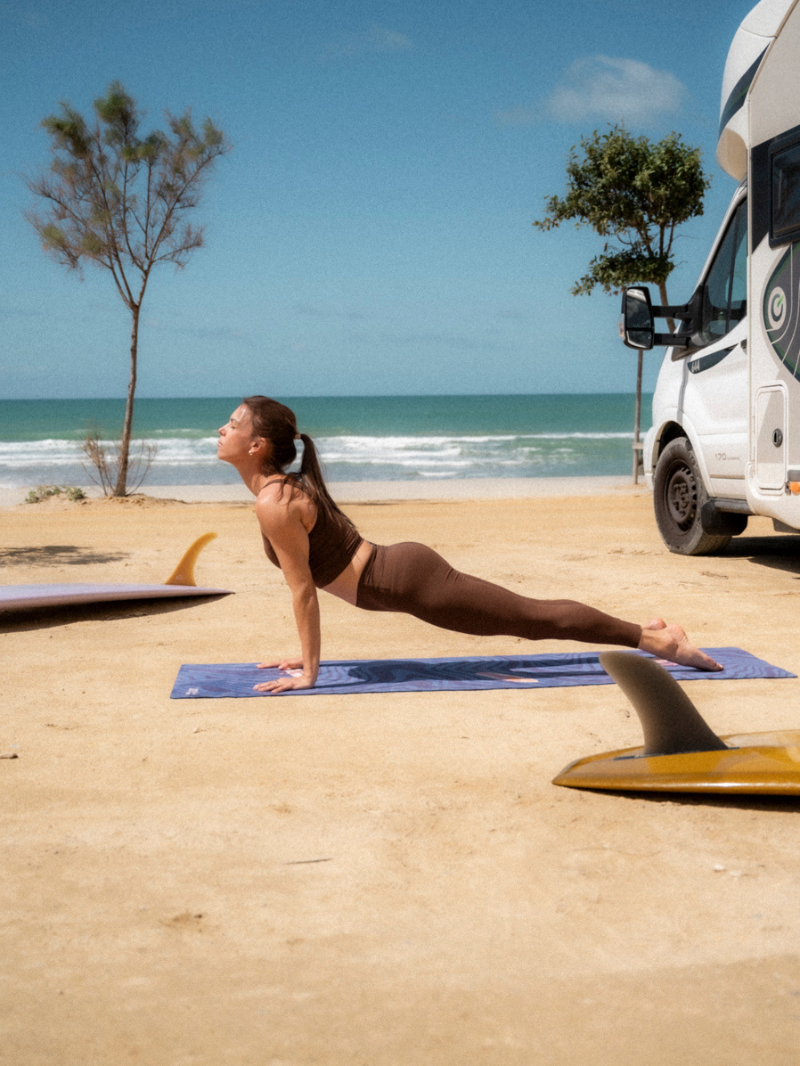
Just like when practicing on the mat, mindfulness and precision matter in facial gymnastics. Sit comfortably on your JOYINME mat, straighten your back, and take a deep breath. Remember that your spine's posture has a direct impact on how the skin sits on your neck and jaw.
Here is face yoga for beginners—a simple set that will take you just a few minutes.
Warm-up and posture
Start with a straight back and relaxed shoulders. Using your fingertips, begin to gently tap your entire face, from the bottom up. Imagine it is a gentle spring rain. This simple action will immediately stimulate circulation and prepare your skin for further face yoga exercises.
Exercise for the forehead and "11s" (The smoother)
Place both palms flat against your forehead so your fingers point toward each other. Press down lightly, preventing the skin from wrinkling. Now, try to lift your eyebrows while resisting the pressure from your hands. Hold for 5 seconds and relax. Repeat 5 times. Feel how the area between your brows becomes smooth and free of tension.
Lifting cheeks and nasolabial folds
Cheeks are the muscles that lose volume fastest. Try the "balloon" technique: fill your mouth with air and move it from side to side, under the upper lip and under the lower lip.
You can also perform the "sun smile"—smile widely, lifting the corners of your mouth high, but be careful not to squint your eyes. This movement brilliantly sculpts the middle part of the face.
Face and neck yoga – a beautiful contour and reducing a "double chin"
To take care of your jawline, perform the so-called "kiss to the ceiling." Direct your chin gently upward (do not tilt your head back too far; protect your cervical spine!). Extend your lips as if you wanted to kiss someone, feeling distinct tension in your neck. You are engaging the platysma muscle, which helps maintain a firm chin.
This set of exercises is a perfect start to introduce conscious care into your daily routine.












Face yoga in your 40s, 50s, and 60s – does age matter?
Are you wondering if this method will still yield results at your age? The answer is yes. Your muscles have an incredible capacity for regeneration and strengthening throughout your life. Only the goals you wish to achieve change.
-
Face yoga in your 40s: This is the time when we focus primarily on prevention. We fight the first signs of gravity and the effects of fatigue. Exercises help keep the tissue properly toned before expression wrinkles have a chance to set in.
-
Face yoga in your 50s and 60s: Here, the main task is working on skin density and improving the contour. Regular gymnastics stimulates collagen production, which naturally fills out the face. It is also time for learning deep relaxation and accepting the changes occurring in your body.
Tip: For mature women, combining gymnastics with a facial massage ritual yields great results. Use a few drops of a natural oil. Gentle stroking and pressing motions further nourish the tissue and will make the skin more elastic.
How often should you do face yoga to see a difference?
One workout a month won't work miracles, but consistency will. The best face yoga is the one you actually do.
We recommend dedicating 5 to 10 minutes to the exercises every day. If you prefer less frequent practice, opt for longer sessions 3-4 times a week. A great advantage of this method is that you do not need special attire. You can exercise in the car while stuck in traffic, in the morning in front of the mirror, or in the evening on your mat as part of your wind-down before bed.
What can you expect over time?
-
Right after the exercises: The face becomes illuminated, and morning puffiness disappears.
-
After 3-4 weeks: You will notice a clear improvement in muscle tone and the smoothing of fine lines. Your features will become softer, and you will feel greater control over the tension in your jaw or forehead.
Face yoga is an act of kindness to yourself. It is that moment in the day when you stop furrowing your brow from worry and start consciously releasing accumulated stress. Combine facial gymnastics with a regular practice on the mat to take care of yourself holistically and feel good in your own skin.
Looking for accessories to enhance your self-care ritual? Check out our exercise mats and comfortable outfits that will make you feel beautiful—from head to toe.